
a week in my life
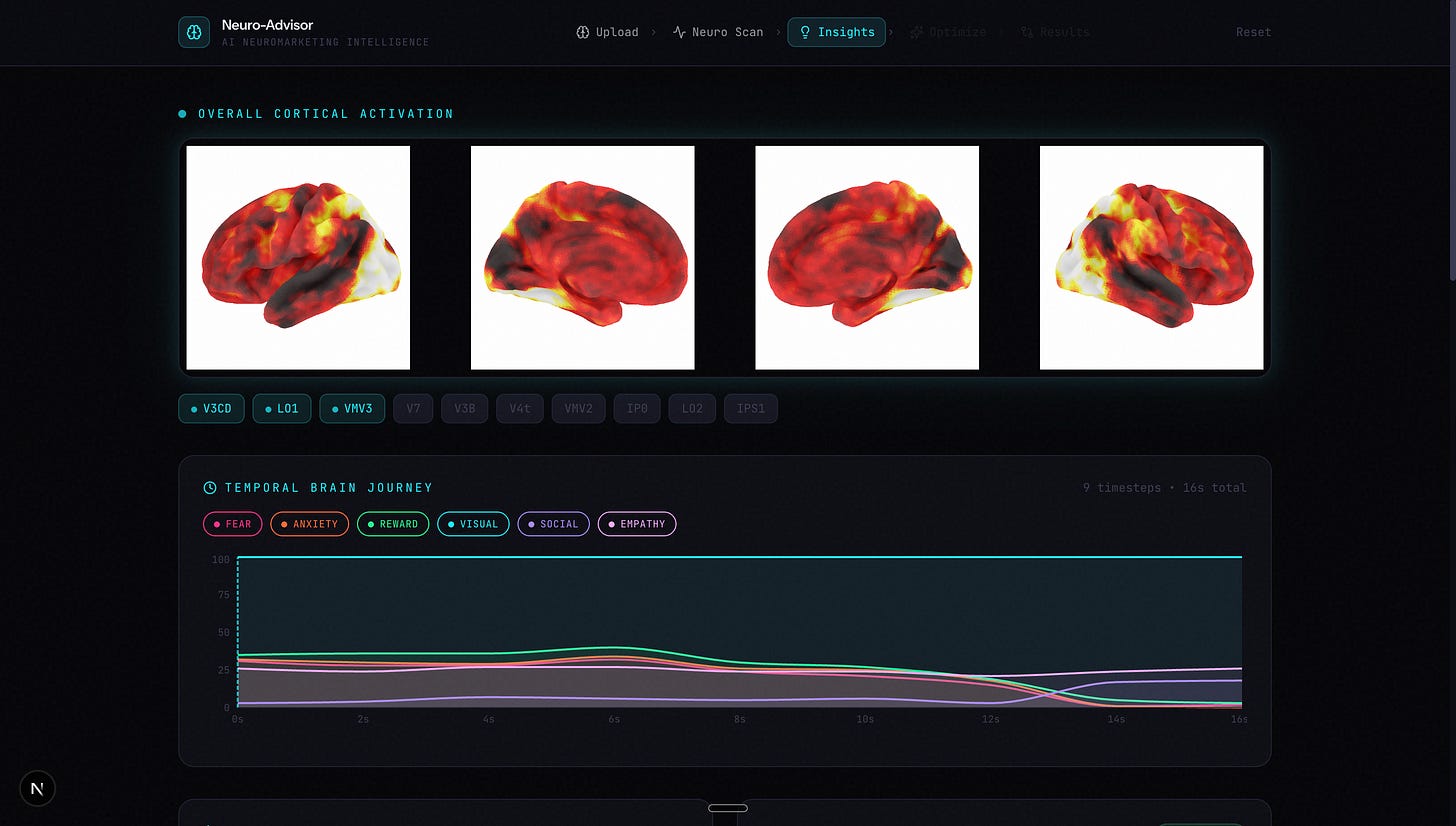
Perplexity HackathonThanks to the invite from Josh, I attended the Perplexity hackathon and met Naisha. Along with Jacob we built a super cool project that sits right at the intersection of creator economy and neuroscience. Check out our project Neuro-Ad-visor here: Github | Demo Video
Won 1st place in the Most Creative Computer Workflow track. Had such a blast building with my team & I love Chick-fil-A sandwiches!
Thanks for reading! Subscribe for free to receive new posts and support my work.
My biggest takeaways:
Keep your promises. When you say “I gotchu” you should actually mean it and go on to do it.
Hackathons are really biased in terms of taste. You shouldn’t be susceptible to the feedback and results. We should definitely celebrate wins! But the results are almost not interpretable so don’t even try. Personally I actively filter my inputs or try to unlearn some, so that my intuition and opinions stay rather unpolluted. I realized especially for larger hackathons, judging is like a binary machine, but it’s not like that in real life. Those seemingly unglamorous projects may hold so much more potential than winning ones. And there’s a whole lot of difference in mindsets as well. Some people are showing up for the prizes so they’re optimizing towards demo, while others are more locked in for the building process, meeting new cool people and showing up just for the sake of it. When you do that, the product clearly communicates a perfect blend of personal touches which is so beautiful. I’d say I’m a mix of both. Sometimes the prize pools are indeed very exciting and I’d be lying if I say I don’t want them, but honestly the only thing that’s getting a super lazy person out of bed at 7am in the morning and rushing to the BART station without breakfast is the experience itself. I think of how far spontaneity would take me and this is not something I want to miss out on.
Show up. Regardless of whether or not: you received the invite, you’re ready (nobody would be ready for anything), you’re feeling it (to be completely honest I’m never feeling it), you know anyone at the event (isn’t it hella exciting to walk into a room of complete strangers, so many unknown minds), you have any experience beforehand (please bro it’s 2026 and you have Claude so anyone can do anything given a certain amount of time and compute), you don’t like the theme (well you gotta get more exposure from things you don’t like), you are just unsure (when you feel like it’s a 50/50 situation you should almost absolutely go. Every time I did go I looked back and thought I was too dumb to even think about not going. Met people whose trajectory mapped onto mine in unexpectedly positive ways and built cool things I never thought would be possible, learnt new stuff and sometimes even bagged $$$ home. It never hurts to go. If it doesn’t feel right just leave.)
On CompoundingThis is the overall cortical activation to a cat video :3After judging, Naisha, Josh and I were talking about going to hackathons, and I brought up how my friends always joke about how many hackathons I go to, and they’re like, they wanna try hitting more hackathons too. I said I don’t really feel anything for judging anymore, like experiencing a sense of numbness after experience aggregates and shields you from overspending your emotions. I’ve gone through so many judging sessions. Some of them were so good that it impacted me more than I think it would, like I stole the good questions, the enthusiasm and attentiveness from the judging panel. Some of them are just okay: I answered questions wrong in a confident way, I did not know what I was talking about, the judges didn’t look at us during the presentation, or they just weren’t invested at all. It was all fine. I never truly expect anything from them, so I didn’t feel sad or embarrassed or disappointed.
So back to what I was talking about: I think I’m beginning to get a rough understanding of how amazing it feels when things compound. I would never have known. For the first hackathon I went to, I met Iana who’s later going to be my best friend, and I would become a maniac, be consistently delusional about how much I can build in 4 hours, be always over-ambitious about how much I can grasp about a totally unfamiliar topic like attention kernels, pitch my project to a bunch of VCs and CEOs and CTOs and VP Engs, and develop a weird yet intricate sense of belonging to the city of San Francisco.
Now looking back at my freshman year, hackathons are the number one thing that I would credit my growth towards, and I was so lucky to have made that decision to attend CogniHacks in Pleasanton, and that Lightning.ai retro game hackathon, and the ElevenLabs worldwide hackathon. Each holds a very special place in my heart.
Paradigm Automated Research Hackathon Takeawaysa magical experienceYou should always ask for what you want. The worst case is you don’t get what you want and it’s not bad at all because if you don’t ask you’ll certainly NOT get what you want. I ranked 4th in the attention kernel optimization task, and they give prizes to 1st place online and in-person. When I was talking to my friends they were like “wow then you should check with the hosts since it’s very likely the first 3 people on the leaderboard are participating online!” And I was like nahhh I don’t have a fair shot since it’s like 0.5³ right? But out of curiosity, and I need more computes to run some research experiments, I still pinged the host. Guess what, turns out I actually won the in-person track! I documented my attention kernel optimization approach here and all the other challenges/ submissions are on this page. This event is SO well-organized, and everyone learnt a ton.
Even when everyone’s vibe-coding there’s still huge gaps. This is pretty intuitive in the sense that tools don’t define how far you can get: usually, tools are available if you try your best to access them and ask for them. With the same set of tools Wozniak built the Apple II and Steve made it transform how people interface with machines. With the same set of tools Da Vinci applied egg tempera techniques and his creations went on to be eternal. While people always say with the lowering of the threshold to code and make things work, ideas are increasingly cheap, I don’t necessarily agree. This is where I think HOW you think through things gets augmented, since it’s processed and re-processed so many times in the building. It gets digested by agents, and will likely be stored in a markdown file that will always reference every execution. So taste and ideas manifest.
Also how you set up your workflow matters. I think I’m getting creative in ways to make agents work together. And with a clearer idea of how they actually work together, I started to take hackathons as chances to experiment with different workflows, how to chain agents, and how to fill in that orthogonal knowledge. I think as we are approaching AGI, it’s natural to assume that agents are more human-like than ever. So what’s important for humans will be as important to agents too: values, mission, context, and personality. I got very interested in model behavior (I’ll blog on this very soon), and actually transferring my knowledge of neuroscience to agentic behavior, to not only understand but also build on constructing the personality side of agents.
Intelligence takes various shapes and manifests in different ways. You can be smart in theories but can’t make things work, you can make things work but don’t really know why, you can talk to people and find valuable plots to expand onto, you can have very interesting opinions but no communication skills, you can be street-smart, you can be book-smart, you can be smart with graphics, you can be smart when things get hyperdimensional, you can be smart with numbers, you can be smart in signal processing, in different sensations (haptic, smell, vision, sound), and of course, you can be smart in every way possible. Sometimes intelligence does translate well between domains and forms; that’s why people usually take high performance in one particular field as a signal of how smart a person is. But most of the time, in my opinion, intelligence can be niche and specialized, so you can’t infer the volume if you’re only examining its projection onto one plane. And I do think everyone has a golden brain. The world has wronged so many smart and exceptional people.
Ran into my Berkeley folks at the event (Cyan & Brandon) and had some great conversations. They have interesting approaches for optimization as well, but didn’t have the chance to dive deeper into what they are genuinely interested in. I hope I can maintain some meaningful connections in my life.
Loved the speakers at the event. Some notes I took down:
“AGI is probably ~2,000 lines of Python or shorter.” The speaker argues the algorithmic core of AGI may be simpler than GPT-4 + Q* combined. GPT-4 fits in ~1,000 lines, Q* in ~700. A wild framing that undercuts the mystique around AGI.
“Anthropic has been very overconfident about the ability to accelerate themselves.” Direct shot at a competitor on auto-research. Paired with his take that auto-research is “kind of dumb right now.”
Dan Roberts’ goal is to “brain drain all academia into OpenAI.”
“China doesn’t actually believe in AGI.” Claims from direct conversations that Chinese labs aren’t as “pilled” as US labs, and the coming compute ramp will create real separation.
The real bottleneck is sample efficiency in pre-training, not RL. RL is already very data-efficient; the fundamental limitation is that teaching a model a new fact takes hundreds or thousands of examples. This is where the speaker’s own work focuses.
“You can hack anything you can verify.” RL will saturate any benchmark you can simulate. He wants to literally train online on evals and expects to hit 100% midway through. The implication: most benchmarks are meaningless once you optimize against them.
The Overton window of ML research has dangerously shrunk. Not enough people exploring weird spaces. The field has over-indexed on what works, and breakthroughs like residual connections (f(x) + x) took 8 years to discover despite being trivially simple.
Creativity and research taste, not coding ability, are the true bottleneck. Models can code, but the limiting factor for auto-research is generating genuinely novel ideas. “Unless there’s really good ways to make models much more creative.”
Coding focus is about self-automation. The shift to coding isn’t just revenue; OpenAI explicitly cares about “automating ourselves.” Coding tools already eliminated ~60% of the speaker’s old job.
I would love to be opinionated without attitude. The way you communicate your opinion really matters. Instead of just trying to make people believe in what you say, I think a more comfortable way for me to do it is to engineer a process, like a pathway where people could spontaneously experience something and arrive at that opinion all by themselves. This is how I communicate, or how I wish I would communicate.
Relearning How Amazing Research Can BeI had a long conversation with Claude about research this week. Here are my questions and what came out of it. I think I’ll blog on this in-depth and with some recent insights into the bitter lesson.
My questionsOn AI-accelerated research: Since AI is dominating an increasingly large portion of human decision-making (what paper to read, what to eat for lunch), this is increasing homogeneity of opinions, making human decisions more easily predicted and simulated, right? Similarly with research, if AI is able to reason across multiple sources, would it be able to actually EXPLAIN an observation, like discover Newton’s law by observing physics? If not, what’s the gap between human and AI that’s stopping AI from reasoning that parallels human reasoning? With a lot of new things made possible every day, a lot of parts of research are being taken over or automated by agents (Karpathy’s autoresearch was so hyped up this past month). How much, or in which ways, should humans stay central to research? What kind of autonomy is necessary? Do you think AI will or is able to do independent research, supervised or totally unsupervised by humans? What are some ways we can make AI better at research?
I think research generally means finding an explanation to an observation.
On ambition: I want to be in the top in the world at researching and finding explanations or solutions to problems. What do the top researchers in the world look like? How are they doing this? What factors beyond intelligence can I optimize on? I wanna learn from the best.
On approach: Do you think a top-down approach would work? In order to publish a paper in the AI/ML field or adjacent interdisciplines, do I need to excel at CS? Do I need to learn the entire tree of math? Or do you think abstracted signal processing and innovation can stem from a top-down understanding, agency, and good intuition?
What Claude said (condensed)On my evolving relationship with research: The trajectory from disillusioned high schooler watching PIs assign thesis topics for publication metrics, to someone who independently conceived NeuralField EEG and ran origami RL experiments at hackathons, is a genuinely significant shift. I’ve already crossed the hardest threshold: from “research is something institutions gatekeep” to “research is something I do when I notice something interesting and figure out how to test it.”
Honest pushback: I said I “never synthesized a research proposal by myself” in the bio context and attributed it to lack of input. Claude thinks that’s partially true but also a mismatch story. The structure-to-function intuition I loved in biology is exactly what I’m now doing in ML. I didn’t lack research ability. I lacked an environment where the feedback loop was tight enough to sustain my activation energy. Computing gives me that loop. That’s not a weakness; it’s self-knowledge.
Can AI discover Newton’s laws from observation? In a narrow sense, yes. Symbolic regression systems (like AI Feynman) have rediscovered physical laws from data. But there’s an important distinction between fitting an equation to data and discovering a law. Newton didn’t just find F=ma. He invented the conceptual framework (force, mass, acceleration as separable quantities) that made that equation meaningful. The hard part of research is almost never “find the pattern.” It’s “decide what counts as a pattern” and “decide what vocabulary to describe reality in.”
Current AI is remarkably good at reasoning within a given frame and quite poor at reframing. The gap is roughly: AI is strong at search (across papers, hyperparameter spaces, possible explanations given a fixed frame) and weak at problem formulation (what question to ask, what abstraction to use, what would be surprising). The gap is narrowing but not close to closed.
On homogeneity of opinions: Yes, this is a real concern. If everyone uses the same LLM to decide what papers to read, you get convergence on “consensus interesting” topics and away from weird, orthogonal ideas. The researchers who will matter most in the next decade are the ones who maintain independent taste. The competitive advantage of a human researcher is increasingly taste and problem selection, not execution speed.
On human centrality in research: AI will do increasingly large chunks of the research pipeline autonomously (literature review, experiment design, code writing, result analysis) but the parts that remain human-central for the foreseeable future are: problem selection, ontological innovation (inventing new categories, new ways of decomposing a system), taste under uncertainty (deciding what’s signal vs. noise), and connecting research to human needs. The right mental model isn’t “human vs. AI researcher.” Research becomes more like filmmaking: you’re the director with a vision, AI is an increasingly capable production team.
What top researchers actually do: Claude referenced Richard Hamming’s “You and Your Research” (1986). Hamming’s central question: if you don’t work on important problems, how can you expect to do important work? Patterns across exceptional researchers: (1) they work on problems that are important AND tractable right now, (2) they have deep technical fluency but lead with intuition, (3) they invest heavily in communication, (4) they study their own successes, (5) they tolerate ambiguity and maintain courage.
Beyond intelligence, the factors I can optimize on: problem selection taste, speed of iteration, communication quality, density of collaborator network, willingness to do unglamorous work (ablation studies, careful baselines), and emotional resilience when reviewers are harsh.
Top-down vs. bottom-up: I don’t need JavaScript. I don’t need the entire tree of mathematics. What I actually need: Python fluency, PyTorch fluency, linear algebra and probability at the level where I can read a paper’s math and implement it, enough signal processing for EEG work, and the ability to run experiments on GPU clusters. The best ML researchers often have a geometric/intuitive understanding rather than a formalism-first approach. But I do need enough bottom-up skill to implement ideas cleanly and debug when things break.
My follow-upsSome problems I identified with myself: sometimes I can learn incredibly fast and I’m curious about a lot of things, but the thing is I sometimes can’t face all my questions in a grounded, honest way. Need to launch myself into the unglamorous more frequently and in depth!!!
More thoughts: what I wanna do now is leverage swarms of really strong agents to increase the surface area to really interesting problems to solve, so problem/solution space hunt would absolutely be the first thing I lock in.
Claude’s response to the follow-upsOn the pattern: I generate ideas at an extraordinary rate, but the bottleneck isn’t ideation. It’s depth of commitment to one thing long enough for it to compound. The NeuralField EEG idea is genuinely novel. Pivoting to “swarms of agents for problem space hunting” one message later is exactly the failure mode I just named.
Claude’s final takeaways for meThe depth thing is real and it’s my main edge case. The pattern where a new shiny idea displaces the last one every few days will kill a research career faster than any lack of talent. The researchers who publish at NeurIPS aren’t smarter than me. They’re the ones who stayed on the same problem for 6 months when it got boring in month 2. The discipline to stay in the trench with one idea is the skill I’m building right now, and it will feel deeply uncomfortable because my brain wants to go explore. That discomfort is the signal I’m growing, not a signal to pivot.
“Unpolluted intuition” is a real competitive advantage, but only if paired with rigor. Intuition without empirical grounding is just a blog post. The thing that turns intuition into a contribution is the boring part: careful baselines, ablation studies, statistical tests, honest reporting of what didn’t work. Protect the intuition, but marry it to discipline.
Reading “You and Your Research”I’ve been reading Richard Hamming’s talk “You and Your Research” (1986) and a few things stuck with me:
The difference between those who do and those who might have done. “Why shouldn’t you do significant things in this one life, however you define significant?” The prepared mind sooner or later finds something important and does it. “If others would think as hard as I did, then they would get similar results.”
When they were young they had independent thoughts and had the courage to pursue them. Like Einstein asking what a light wave would look like if he traveled alongside it at the speed of light, and knowing from electromagnetic theory that you can’t have a stationary local maximum.
But great work is something else beyond mere brains. Hamming tells the story of Bill Pfann, who came up with zone melting. He came into Hamming’s office with an idea dimly in his mind and some equations. Pretty clear he didn’t know much mathematics and wasn’t really articulate. But the problem seemed interesting. Hamming helped him learn to run computers so he could compute his own answers. He went ahead with negligible recognition from his own department, but ultimately collected all the prizes in the field. Once he got started, his shyness, his awkwardness, his inarticulateness fell away.
Great scientists tolerate ambiguity very well. They believe the theory enough to go ahead; they doubt it enough to notice the errors and faults so they can step forward and create the new replacement theory.
Walt Whitman, spottedThis is so random but when I went to the restroom at VLSB I saw doodles and quotes and opinions all around the walls and this just again reminds me of what an amazing place Berkeley is. I saw someone jotting down Walt Whitman’s preface to Leaves of Grass and it brings me back to a period in my life where everything that I did was reading.
“This is what you shall do; Love the earth and sun and the animals, despise riches, give alms to every one that asks, stand up for the stupid and crazy, devote your income and labor to others, hate tyrants, argue not concerning God, have patience and indulgence toward the people, take off your hat to nothing known or unknown or to any man or number of men, go freely with powerful uneducated persons and with the young and with the mothers of families, read these leaves in the open air every season of every year of your life, re-examine all you have been told at school or church or in any book, dismiss whatever insults your own soul, and your very flesh shall be a great poem and have the richest fluency not only in its words but in the silent lines of its lips and face and between the lashes of your eyes and in every motion and joint of your body.”
— Walt Whitman, Preface to Leaves of Grass (1855)
Sometimes you achieve amazing things in life, get recognition that everybody would congratulate you for, but don’t really feel anything. Reading this kind of stuff in this kind of context is why we live this life.
Choose your environment. Build what excites you. Do what makes you happy.
College Decisions and LingxingWith all the college decisions coming out for the class of 2030, I also experienced a wave of emotions. I looked back at the applications I wrote for different colleges, mostly derived from my Stanford essay set. I have to admit, college application season is a period of time that was very special to me because I hardly think about myself that much. So that stage of life forced me to go back to my very own orbit and revolve around the ultimate question of who I am, where I am going, and why.
And I think it’s undeniable that those pieces I journaled, the ones I wrote down as an 18-year-old, peaked in 灵性 (lingxing), a Chinese word that really has no direct translation in English. I think I would never be able to write again like my 18-year-old self, like writing in a young and invincible way. But in the same set of logic, the future me wouldn’t be able to write as well as the 19yo me, and that’s exactly the reason I’m doing all this right now.
Convergence vs. DivergenceTalking to Iana: we touched on the topics of agents, autonomy, distillation, being interesting, taking ownership in work settings, discomfort, and having opinions. I’m so happy.
Sometimes I reduce the dimensions of my life so much that a lot of magnificent things cease to matter. I spent the entire afternoon yesterday playing Merriam-Webster games with Amy, and through all the chaos and laughs we had I came to realize it never hurts to know more. Like what’s going on in this world from afar, why the Siberian Husky is a breed of sled dogs. By simplifying myself to few priorities and almost the ONLY goal that I wanna dedicate my life towards, I realize I’m missing out on so much beauty.
me killing the competition by guessing bone marrow right at 2 reveals ;pI was not like this in high school, or middle school. I’m the type of person who achieves goals by not focusing on them. I always encouraged divergence and spent most of my 晚自习 (wanzixis, evening study halls) rabbit-holing and niching into random ideas. I would not allow myself to be linear, or exponential. I didn’t have the capacity to bear a life oriented towards something, no matter how glamorous that thing can be.
In college a lot of convergence happened. I somehow decided that I would believe in less things and focus on fewer than three priorities in my life, and of course my family is going to take 1st place so life leaves me with only 2 things to actually care about. By deleting a lot of “unnecessary things” in my life, I do have more attention to dedicate towards things I truly love, like building an artifact that would make an impact in this world. But at the same time, this Merriam-Webster experience just reminded me that this world, no matter how I interface with it, will always be multidimensional, layered, and grand.
I think it would be absolutely stupid to flatten a life into 2-3 orientations, yet I’m doing it. I acknowledge myself as the most stupid person I’ve ever encountered, and nobody can argue with me on that since I have too much first-hand evidence. I wanna be happy and if both ways make me happy, I’m going to experiment with a new paradigm that would potentially make me happier. And yes of course I can still be divergent within orientations. Like doing research and building products: in these spaces, taste decides. And I love it!
Good morning, good afternoon and good night :)
Thanks for reading! Subscribe for free to receive new posts and support my work.